Ping Pong
POWER
Welcome to WholeTable: Connecting pros, players, and the planet.
Why Recycle Rubbers
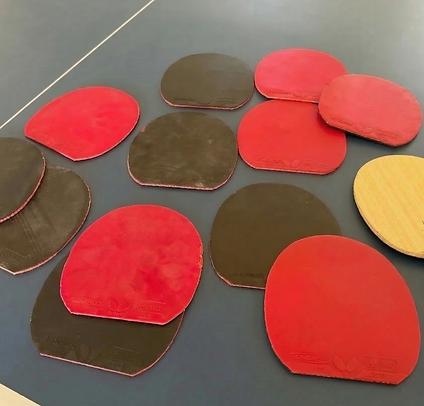
Elite table tennis players change their rubbers incredibly frequently—often replacing them every 3 to 7 days during regular training blocks. During major competitions like the World Championships or the Olympics, top-tier professionals (such as those on the Chinese National Team) change their rubbers every 1 to 2 days, or even glue up a fresh sheet for a single, high-stakes match. Club players change their rubbers every 3 to 6 months.
Because of the high volume of rubbers discarded globally—especially by competitive players who change them frequently—this creates a compounding environmental issue:
-
They are not biodegradable. Table tennis rubbers are not made of pure, natural rubber. They are highly engineered products manufactured using a blend of natural rubber and synthetic polymers (like polyisoprene and butadiene). Furthermore, the rubber undergoes vulcanization—a chemical process that hardens the material to make it durable and elastic. This process makes the rubber incredibly resistant to natural decay, meaning a discarded sheet can sit in a landfill for decades, if not centuries, without breaking down.
-
They are challenging to recycle. Standard recycling facilities cannot process table tennis rubbers. A sheet of rubber is actually a composite material made of two distinct layers: the topsheet (the pimpled, grippy surface) and the sponge (the porous, underlying layer). These two layers are permanently fused together during manufacturing, and then glued to a wooden blade by the player. Because recycling centers require materials to be easily separated into pure streams (like plain plastic, glass, or paper), the mixed nature of table tennis rubbers, combined with residual glues, makes them non-recyclable in traditional municipal systems.
-
Chemical leaching. Modern rubbers are heavily treated. They contain colored dyes (typically red, black, pink, green, blue, or violet), factory-applied chemical boosters (to expand the sponge), and preservatives. When exposed to the elements in a landfill, these synthetic chemicals, along with the remnants of water-based or VOC (volatile organic compound) glues used to attach them to the blade, can eventually leach into the surrounding soil and groundwater.
-
Microplastics generation. Like car tires and shoe soles, synthetic table tennis rubbers will eventually degrade and become brittle over a very long timeline. When they do break apart, they fragment into microplastics. These tiny synthetic particles can easily be washed into waterways, contributing to the broader global microplastic pollution crisis.
Our Journey: From Insight to Impact
During a 2024 visit to rural China, founder Michael Chang witnessed a striking contrast: a deep passion for table tennis paired with a severe shortage of equipment. While visiting relatives, he noticed that young players were often held back by the prohibitive cost of high-performance rubber.
He realized that "retired" rubber from competitive players—though no longer suitable for professional tournament play—still offered elite performance for developing youth. Recognizing that these materials are lightweight and highly portable, he saw a practical way to bridge the gap between wasted resources and eager young athletes.
He turned this vision into reality. After intensive outreach and logistical coordination, we are proud to have established three distribution centers in China: Xiuyan, Jingxian, and Ma'anshan. Building on this momentum, we are now exploring our another international expansion into Nepal.

Supporting Teams
A massive thank you to the following:
Our three big club sponsors
Our Tireless Volunteers
Every single player who has chosen to donate their used gear instead of throwing it away
